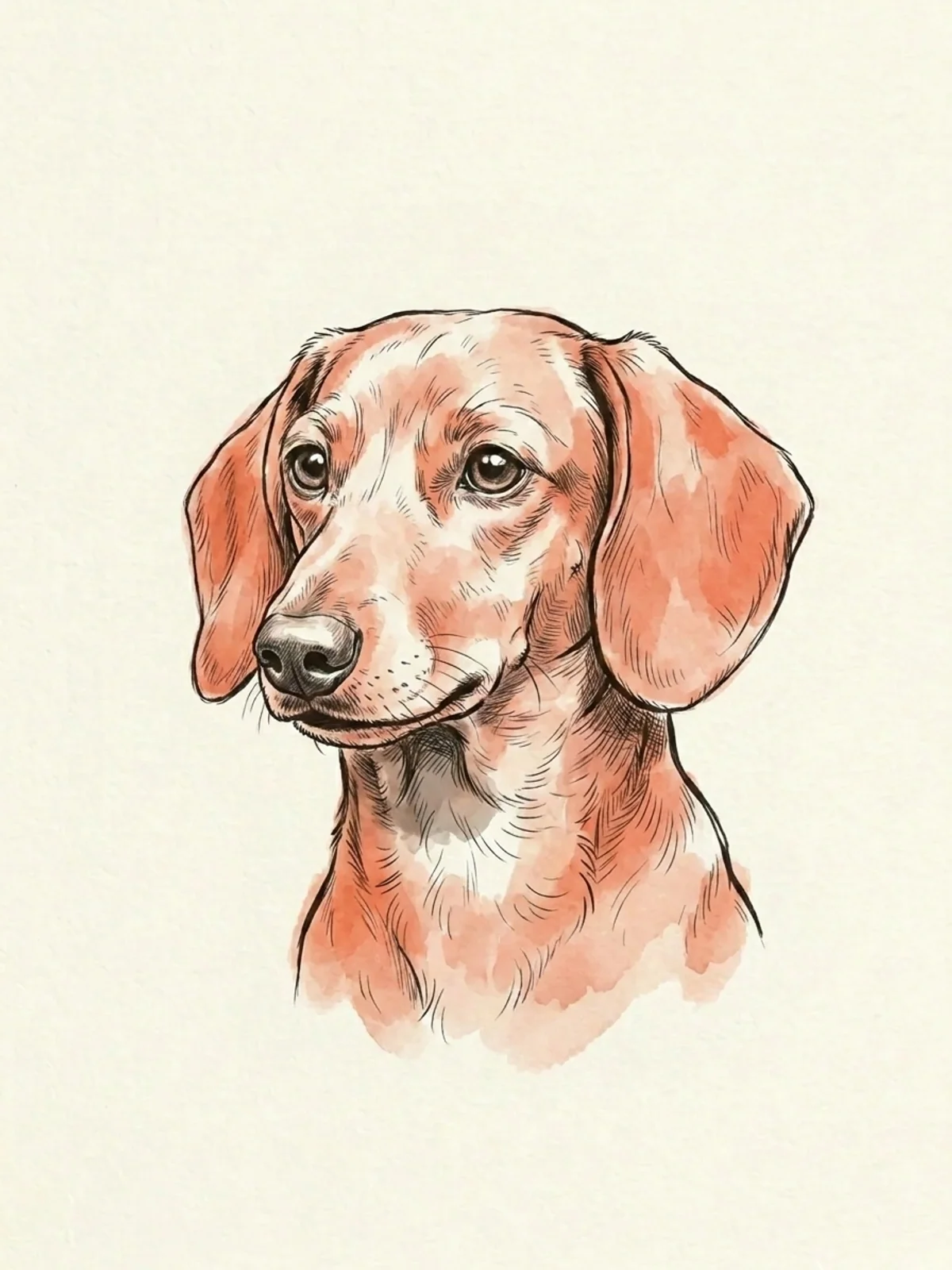
The oldest verified Dachshund on record lived to 25. The most recent Guinness title-holder, a miniature Dachshund named Funny, hit 21 years and 169 days in November 2020. The typical Dachshund today lives 12 to 16 years, comfortably above the all-breed average of about 11 years, which sounds straightforwardly good for a small breed, until you look at the UK clinical data variety by variety and find that one type bottoms out at 7.3. The single biggest variable in a Dachshund’s life expectancy is the spine, not age, weight, or diet, and what the published research actually says about protecting it is the opposite of what most owners hear from well-meaning friends.
Key facts
- Typical lifespan: 12 to 16 years; UK clinical median 7.3 years for Miniature Smooth, 10.9 for Miniature Wire
- Signature disease: IVDD, with relative risk 10 to 12 times higher than other breeds
- IVDD lifetime prevalence: 15.3% owner-reported in a 2025 JAVMA study (n=43,517), onset typically ages 3 to 7
- Counterintuitive prevention: dogs exercising over 1 hour/day had lower IVDD odds; restriction did not help
How long Dachshunds actually live
Most pet-owner-facing sources put the Dachshund lifespan in the 12 to 16 year range, with 15 a common headline number per Alpha Paw. Miniature Dachshunds (under 11 lbs) often reach 17 to 18 years in healthy households.
UK clinical data tells a more granular and somewhat darker story. A recent variety-by-variety analysis reported by Dachshund Health UK found the Miniature Smooth Dachshund had a median lifespan of 7.3 years, the lowest of any variety. Miniature Wire Dachshunds reached 10.9 years and Standard Long Dachshunds 10.4 years. The variety-level gap is enormous (7.3 versus 10.9 years inside one breed is the kind of difference that would dominate any conversation about, say, three different breeds). The discrepancy with US owner-survey numbers reflects the usual clinical-versus-survey skew, but the variety-level signal is real and worth weighing if you are choosing a puppy.
IVDD is the breed story
Intervertebral Disc Disease is to Dachshunds what BOAS is to French Bulldogs: a signature condition baked into the body plan. Dachshunds carry an FGF4 retrogene insertion on chromosome 12 that causes chondrodystrophy, the dwarfism that gives the breed its iconic shape and predisposes its discs to early calcification and herniation per the PMC FGF4 paper.
The numbers are stark. Dachshunds have a relative risk of IVDD 10 to 12 times higher than other breeds, with 19 to 24 percent showing clinical signs during their lifetime per the DachsLife 2015 PMC paper. A more recent 2025 JAVMA study of 43,517 US dogs found Dachshunds had the highest owner-reported lifetime IVDD prevalence at 15.3 percent per JAVMA. Onset is typically between ages 3 and 7, often in dogs with no prior symptoms. A single herniation can take a Dachshund from running on the beach to dragging the hind legs within hours.
What the research actually says about preventing IVDD
This is where most articles get it wrong, and where the published research is genuinely surprising.
The DachsLife 2015 study analysed risk factors across thousands of Dachshunds and found that dogs exercising for less than 30 minutes per day had higher odds of IVDD, while dogs exercising for more than 1 hour per day had lower odds. Dogs whose owners restricted jumping on and off furniture also showed higher odds of IVDD, not lower. Glucosamine and chondroitin supplementation was associated with increased odds, possibly because dogs already showing back symptoms were the ones being supplemented in the first place.
Physical conditioning protects the spine more than physical restriction does. A muscular, active Dachshund spreads the load across paraspinal muscles; a sedentary one passes the load directly through the discs. None of this means you should encourage a Dachshund to launch off a kitchen table. Catastrophic single events still matter. It does mean that the standard owner advice of “minimal jumping, supplements, gentle walks” is not protective in the way most people assume.
For breeders, the FGF4 DNA test exists but is not recommended as the sole selection criterion because nearly every Dachshund carries the variant per the Springer breeding-schemes paper. Radiographic disc calcification scoring is the practical screening tool: fewer than five calcifications by age two correlates with substantially lower IVDD risk, with sensitivity 0.79 and specificity 0.91.
What you can actually do
Three actions change the odds for a Dachshund, in order of evidence strength, alongside the general principles of extending a dog’s lifespan that apply to every breed.
Build aerobic conditioning, not restriction. Target more than one hour of moderate activity daily, ideally split across two or more sessions. Off-lead time on grass, swimming, and trotting on a long line all build the paraspinal musculature that the disc disease research consistently links to protection. The dog you raise as a couch ornament is the dog who will herniate at age four.
Keep weight tight. Body condition score 4 of 9, no exceptions. A Dachshund carrying excess weight loads the discs every step they take, every staircase they descend, every jump they manage despite your best efforts. Lean Dachshunds tolerate the breed’s structural compromise far better.
Prepare for the spinal lottery. If you are buying, ask the breeder for calcification scoring of the parents, not just an FGF4 DNA result. If you already own a Dachshund, get pet insurance that explicitly covers spinal surgery; the procedure runs 6,000 to 12,000 USD and most general policies have orthopaedic exclusions buried in the fine print. The 20 percent chance your Dachshund develops symptomatic IVDD is a high enough probability that planning for it is just arithmetic. Every year counts.
See your Dachshund’s real age with the calculator, which uses the small breed curve to give you a number that is actually true for your dog.