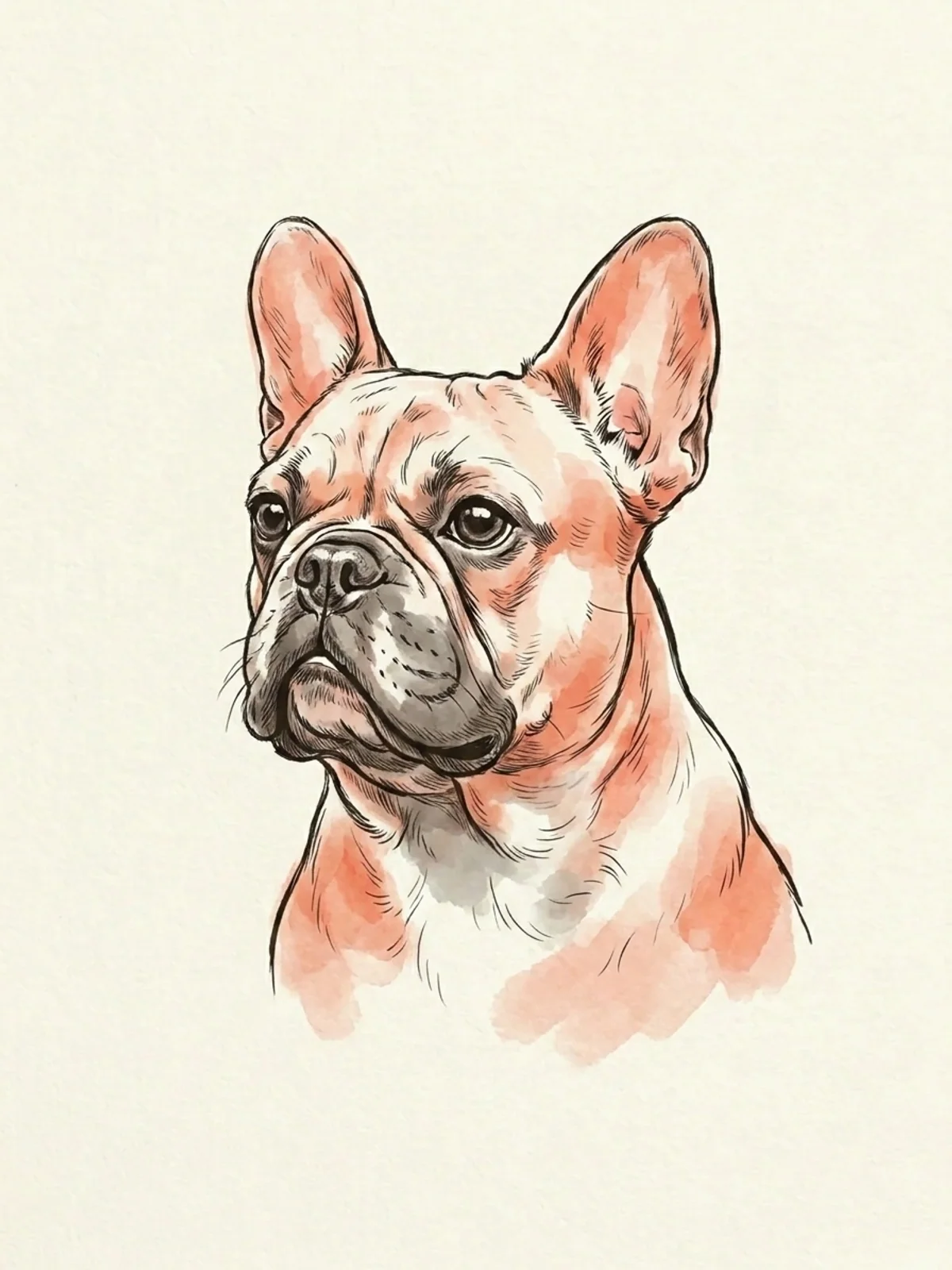
The French Bulldog is the most popular dog breed in the United States and has been since 2022. It is also the breed with the shortest life expectancy in the most rigorous UK study ever conducted on canine longevity. Both of these things are true at the same time, and a sensible owner needs to understand what the numbers actually say before deciding what to do about them. Most published sources put the typical Frenchie at 9 to 11 years, noticeably below the all-breed average of about 11 years. The most carefully controlled research puts the average meaningfully lower. The gap matters, and what owners control inside the gap matters even more.
Key facts
- Typical lifespan: 9 to 11 years (most sources, ~9.8-year average), below the ~11-year all-breed average.
- VetCompass 2022 (Nature Sci. Reports, 30,563 dogs) gave Frenchies the shortest expectancy of any breed: 4.53 years.
- A 2026 German health survey found a mean age at death of 8.3 years, with cancer causing 47% of deaths.
- IVDD recurrence after surgery is 52.7%; ~33% of paraplegic Frenchies develop fatal myelomalacia (vs 10 to 15% in non-chondrodystrophic breeds).
Owner-facing sources commonly cite a Frenchie lifespan of 9 to 11 years, with some quoting an average around 9.8 years. A 2026 health survey of German French Bulldogs put the mean age at death at 8.3 years, with cancer responsible for 47 percent of deaths per the PMC German Frenchie health survey.
The most rigorous figure comes from the Royal Veterinary College’s VetCompass programme. Their 2022 Nature Scientific Reports paper analysed 30,563 dogs that died between 2016 and 2020 and found a UK all-breed life expectancy at age 0 of 11.23 years. French Bulldogs in that dataset had the shortest expectancy of any breed studied at 4.53 years (95 percent confidence interval 4.14 to 5.01). The figure is shocking on first reading, and it is real, but it reflects primary-care veterinary records from a population that includes the most extreme modern conformations. A French Bulldog bred from healthier parents with longer snouts and intact, mobile spines is not destined for the 4.53-year average. The breed-level statistic is a sentinel signal, not a verdict on any particular dog.
BOAS, the airway crisis built into the face
Brachycephalic Obstructive Airway Syndrome is the most defining health problem in the modern French Bulldog. It arises from a mismatch between the proportions of the skull and the soft tissues inside it: an elongated soft palate, stenotic (narrowed) nostrils, oversized tongue, narrow trachea, and everted laryngeal saccules per UFAW. The result is a dog that cannot breathe efficiently at rest, cannot cool itself through panting the way a typical-face dog does, and is at elevated risk of sudden death from airway obstruction or heat stroke.
A barometric plethysmography study published in PMC found that the majority of French Bulldogs sampled showed measurable airflow obstruction even when their owners did not perceive any breathing problem. The everyday snorting, snoring, and reverse sneezing many owners consider charming is the audible expression of a serious physiological compromise. BOAS surgery (combined soft palate resection, alar fold removal, and saccule excision) measurably improves quality of life and survival in moderate-to-severe cases, though the procedure addresses symptoms rather than the underlying conformation.
IVDD and the spinal disease problem
French Bulldogs are chondrodystrophic, meaning they carry a genetic mutation that causes early disc degeneration. Intervertebral Disc Disease (IVDD) is correspondingly common and severe. After surgical treatment, 52.7 percent of French Bulldogs experience recurrence per a PMC retrospective study, and approximately 33 percent of paraplegic, sensation-negative Frenchies develop myelomalacia, the fatal progressive softening of the spinal cord, compared to 10 to 15 percent in non-chondrodystrophic breeds.
A 2025 Frontiers paper found that neuter timing affects IVDD risk, with implications for when to schedule the procedure per Frontiers in Veterinary Science. The practical signals matter: Frenchies should not be encouraged to jump from furniture, should sleep on supportive bedding rather than sagging cushions, and should be carried up and down stairs once they show any back stiffness. Pet insurance is not optional for this breed; orthopaedic neurosurgery routinely runs 8,000 to 15,000 USD, and 52.7 percent of those surgeries will face a second incident.
What you can actually do
Three decisions change the odds for a French Bulldog, in rough order of impact, and the general principles of extending a dog’s lifespan apply on top of these breed-specific ones.
Choose the right dog at the start. If you are buying, look for a breeder selecting toward a longer snout, more open nostrils, and shorter back. Ask for the puppy’s BOAS grade (the Cambridge BOAS Research Group has a 4-point grading system) and the parents’ spinal imaging. A puppy from grade 0 to 1 parents has a measurably different lifetime health trajectory than a puppy from grade 2 to 3 parents, even though both are sold under the same breed name.
Manage heat aggressively. A Frenchie should not exercise above approximately 20 degrees Celsius (68 Fahrenheit). Heat stroke in this breed is a medical emergency that kills quickly, and the typical owner underestimates how fast it progresses. Carry water, keep walks short and shaded, and accept that mid-day summer activity is off the table.
Keep weight under control and the spine respected. Every excess pound on a Frenchie compounds both the airway and spinal load. Body condition score 4 of 9, no leaping, ramps for the couch, and a real pet-insurance policy with orthopaedic coverage are the operating defaults for this breed. The typical Frenchie lives somewhere in the 9 to 11 range, and the dogs that reach 12 or 13 share a pattern: healthier conformation, attentive owners, and luck with the spinal lottery. Every year counts.
See your French Bulldog’s real age with the calculator, which uses the small breed curve to give you a number that is actually true for your dog.