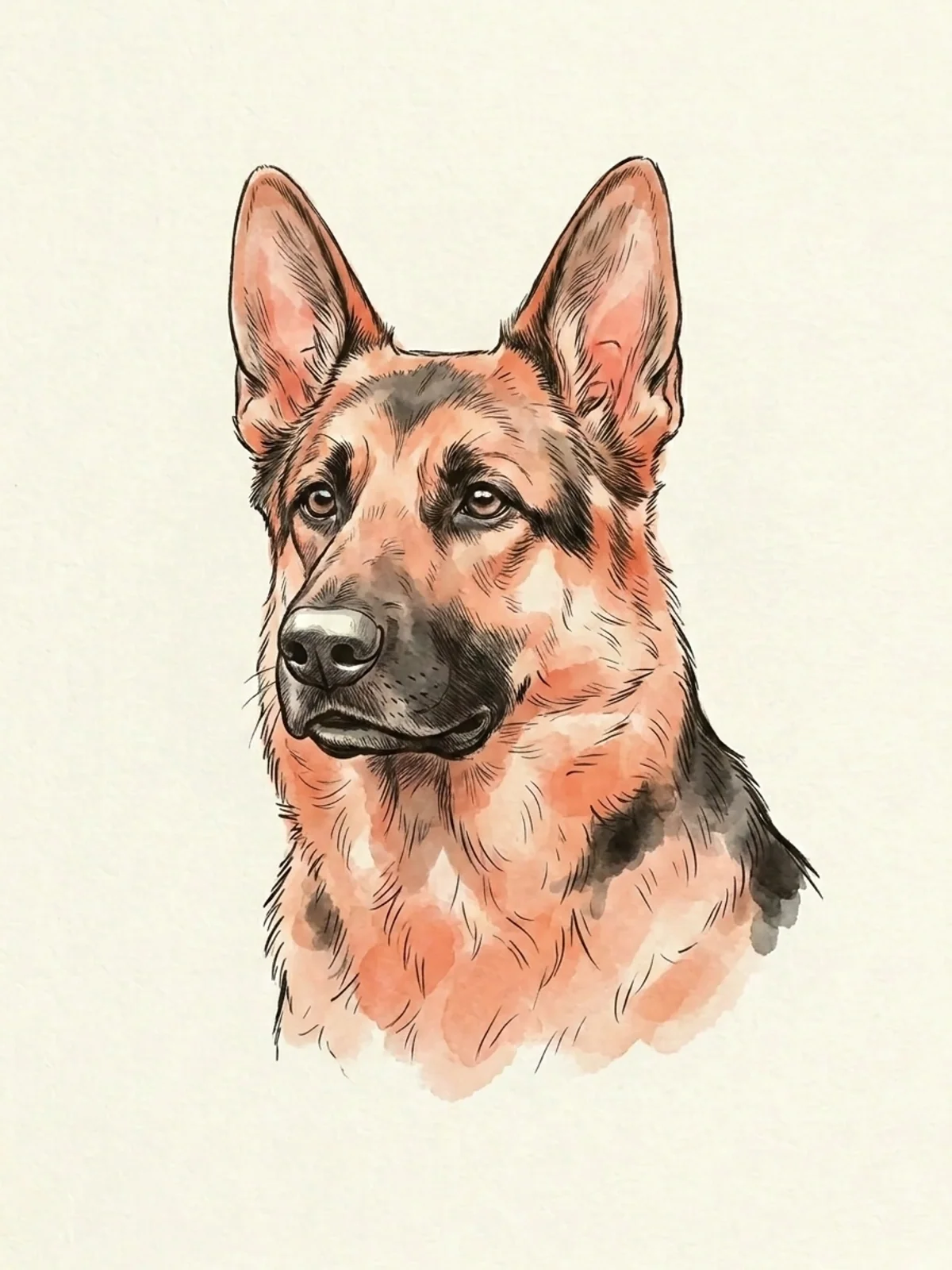
The German Shepherd’s signature health condition is so closely tied to the breed that veterinarians sometimes call it “German Shepherd disease.” Degenerative Myelopathy, a progressive paralysis of the hind legs caused by a single inherited gene, is the canine equivalent of ALS. It is also entirely genetic, entirely diagnosable from a cheek swab, and entirely missing from most lifespan articles about the breed. The typical German Shepherd lives 9 to 13 years, with the median sitting closer to 10. The bigger story is the one inside that range: working-line dogs trend longer than show-line dogs, and the gap is not small.
Key facts
- Typical lifespan: 9 to 13 years, median closer to 10; AKC lists a more conservative 7 to 10 years.
- Degenerative Myelopathy is caused by a recessive SOD1 mutation (the gene also implicated in human ALS) and is diagnosable by cheek swab.
- DM typically presents at ages 8 to 14; most affected dogs are euthanized within 6 to 24 months of diagnosis.
- Show lines bred for back slope show worse hip and elbow dysplasia, shortening active lifespan.
The average German Shepherd lives 10 to 11 years per German Shepherd Pet’s 2026 health statistics summary, with the typical range spanning 9 to 13 years, which puts the breed just under the all-breed average of about 11 years. A 2024 Italian canine study placed the breed median at 10 years. The American Kennel Club lists the breed at a more conservative 7 to 10 years, which probably reflects an emphasis on registered show-line dogs in their dataset rather than the breed as a whole.
The honest number depends heavily on which Shepherd we are talking about. Working-line GSDs bred for police, military, or sport work appear to live longer in good health than the heavily-angulated show lines, though precise lifespan-by-line data from peer-reviewed sources is thin. What is well documented is that the show conformation carries measurably worse orthopaedic outcomes, which translate to earlier mobility loss and earlier euthanasia decisions. The reason takes the next two sections to unpack.
Degenerative Myelopathy, the German Shepherd disease
Degenerative Myelopathy (DM), also called chronic degenerative radiculomyelopathy, is a progressive disease of the spinal cord that produces slow hind-limb weakness, then paralysis, then loss of bladder and bowel function. It typically presents between ages 8 and 14 per UFAW. The progression is painless but relentless, and most affected dogs are euthanized within 6 to 24 months of diagnosis as quality of life deteriorates.
The cause is a mutation in the SOD1 gene, the same gene implicated in some forms of human ALS per the PMC molecular epidemiology study. The mutation is recessive, which means a dog needs two copies to develop the disease, but carriers (one copy) can still pass it on. Cheek-swab DNA testing is widely available for about 60 to 80 USD, and reputable breeders test their breeding stock and disclose results. If you are buying a puppy, ask. A breeder who cannot or will not provide SOD1 results is telling you something important about their priorities.
There is no cure. There is no proven prevention. There are management strategies (physical therapy, mobility carts, careful weight management) that extend quality time, but the disease itself runs its course. Buying from tested parents is the only intervention that actually moves the needle on incidence, which is why the SOD1 conversation belongs at puppy selection, not at age 8.
Why show lines die younger
The modern show-line German Shepherd looks different from the working-line dog by design. Show breeders have selected for a dramatic backline slope and angulated hindquarters, ostensibly for “smoother gait.” Working-line breeders have kept the original straight-back, level-topline conformation that the breed founder, Max von Stephanitz, actually drew up.
A 2020 conformation study in the PMC biomechanics literature found that German Shepherds with greater back slope show measurably different gait mechanics: greater vertical forelimb forces, increased mid-thoracic flexion, and altered weight distribution. The downstream consequences are hip and elbow dysplasia, intervertebral disc disease, and earlier orthopaedic failure. Show-line GSDs are more prone to hip and elbow dysplasia per multiple veterinary reviews including Mittelwest, which translates directly into shorter active lifespans and earlier euthanasia decisions when mobility collapses.
The takeaway for a prospective owner is concrete. If lifespan and joint health are priorities, working-line breeders consistently produce healthier dogs than show-line breeders. If you are choosing a puppy, ask which line, look at the parents’ OFA hip and elbow scores, and look at the parents’ topline in profile. A flat back is what the breed was designed to have.
What you can actually do
Three actions change the odds for a German Shepherd, in order of evidence strength, layered on top of the general principles of extending a dog’s lifespan.
Test the parents before buying, then test your dog. SOD1 cheek-swab testing for DM, OFA hip and elbow scoring at 1 to 2 years, and basic cardiac auscultation are the minimum genetic and structural workups. The dollar-per-year-of-life return on this work is the highest in the entire breed.
Manage weight aggressively. The Purina lean-body study in Labradors found a 1.8-year median lifespan extension from caloric restriction alone, and the principle generalises to other large breeds. A German Shepherd carrying 15 percent excess body weight will reach orthopaedic failure 1 to 2 years earlier than a lean Shepherd of the same genetics. Feed measured meals, weigh the dog every two months, target body condition score 4 or 5 on the 9-point scale.
Build muscle on the hindquarters. German Shepherds are designed to be working dogs, and a sedentary Shepherd loses hindquarter muscle mass quickly. Once the muscle is gone, hip and spinal structures compensate poorly, and the cascade toward early arthritis accelerates. Two structured walks daily, with at least one including hill work or stairs, keep the engine assembled. For this breed, hill walks function as a medical intervention, not a lifestyle choice.
The median German Shepherd lives 10 to 11 years. A working-line, lean, genetically tested, well-exercised Shepherd routinely reaches 13 to 14. Every year counts.
See your German Shepherd’s real age with the calculator, which uses the large breed curve to give you a number that is actually true for your dog.