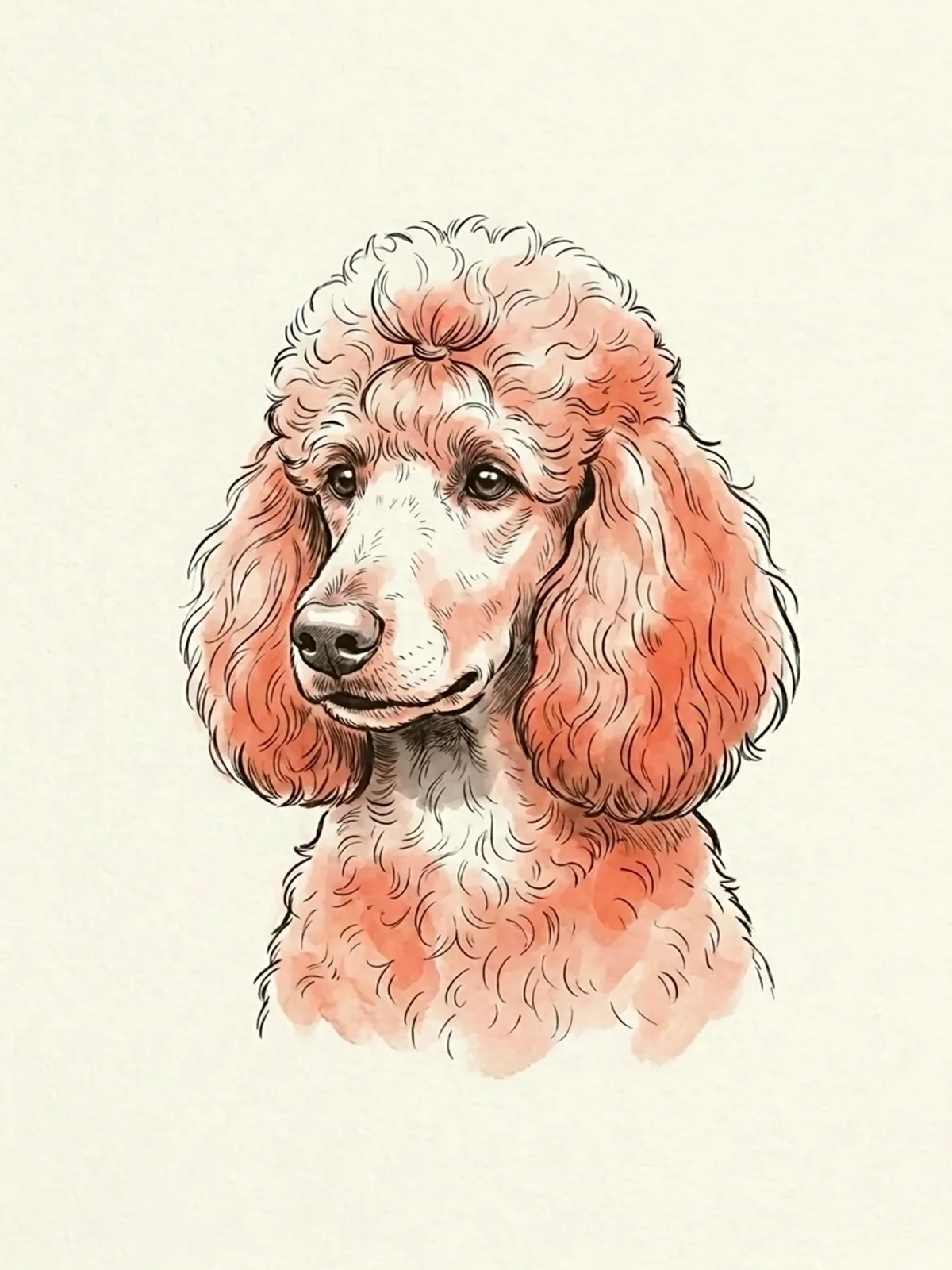
A Toy Poodle and a Standard Poodle share a stud book, a coat type, and almost everything a breed standard formally describes. They do not share a lifespan. A Toy reaches a median 15 years; a Standard is doing well to reach 12. Same breed, completely different actuarial outcome. The Poodle is one of the very few breeds where the within-dog size-lifespan curve is observable inside a single pedigree, and that is the most useful lens for any owner trying to figure out what to expect.
Key facts
- Lifespan by variety: Toy 15-year median, Miniature 14.2 years, Standard 11 to 13 years
- Toys outlive Standards by roughly three years on the median
- Standard-specific risks: Addison’s disease (1.17% prevalence vs 0.1% general) and sebaceous adenitis
- Standards also carry measurable bloat (GDV) risk; Toys and Minis do not
- Miniature mortality: cancer 18.5%, neurological causes 13.9% (University of Georgia cohort)
How long Poodles actually live by variety
The three Poodle varieties post three different median lifespans, and the gap is larger than most owners realise.
Toy Poodles (under about 10 lbs) hold the longest median, well clear of the all-breed average of about 11 years. A 20-year Banfield/University of Georgia mortality dataset put their median lifespan at 15 years, and a 2024 UK life-table reported a breed-level life expectancy of 14 years, well above the 12.7 average for purebred dogs per the PMC UK life tables study. Reaching 17 or 18 is unremarkable for a well-bred Toy with reasonable luck.
Miniature Poodles (10 to 15 lbs, roughly 11 to 15 inches at the shoulder) sit just behind. The historic VetCompass dataset cited in the Wikipedia breed entry reports a median age at death of 14.2 years. The same University of Georgia cohort flagged neurological causes (13.9 percent) and cancer (18.5 percent) as the leading mortality categories for Minis, alongside mitral valve disease as a frequent late-life finding per PetMD’s Miniature Poodle profile.
Standard Poodles (40 to 70 lbs) are the outlier. Most breed-club and AKC summaries cite 11 to 13 years, with 10 to 12 the more honest centre once you weight for the breed’s autoimmune and gastric risks. They are long-lived by medium-large standards, but they are not living the 15-year life their smaller cousins manage. The within-breed size-lifespan delta is real: a Toy outlives a Standard by roughly three years on the median, which is the same magnitude as the gap between a Labrador and a small terrier. It is the small-dog-lives-longer rule playing out inside one pedigree.
Why Standards lose years the smaller varieties do not
Standard Poodles carry two breed-specific autoimmune diseases that the Toy and Miniature lines largely escape, and one acute emergency that the size alone makes inevitable.
Addison’s disease (primary hypoadrenocorticism) is the headline. Standards develop it at roughly 1.17 percent population prevalence, compared with about 0.1 percent in the general dog population, per the PMC Swedish epidemiological study of 525,028 dogs. Heritability is high, and the PMC genetic-bottleneck paper traces the increase to mid-twentieth-century show breeding that funneled 50 to 60 percent of modern Standard Poodle ancestry through a handful of founders. The good news is that medicated Addison’s dogs typically live a normal lifespan. The bad news is that an undiagnosed Addisonian crisis (collapse, vomiting, electrolyte derangement) is a frequent first presentation, and the dogs that die of it die suddenly.
Sebaceous adenitis, an immune-mediated destruction of the skin’s sebaceous glands, is the second autoimmune signature. It is not usually fatal but is lifelong, and the same founder bottleneck drove its rise per the Springer companion-animal genetics paper.
The acute risk is gastric dilatation-volvulus (bloat). Standard Poodles are on the short list of breeds with measurable lifetime GDV risk alongside Great Danes, Irish Setters, and Weimaraners per the PubMed Glickman cohort study. Toys and Miniatures simply do not have the deep chest geometry to bloat in clinically meaningful numbers. A prophylactic gastropexy at the time of neuter or spay is increasingly the recommendation for Standards from breeders aware of the cohort data. None of these conditions are common enough to dominate a Standard Poodle’s life. They are common enough to explain the three-year gap.
What the smaller varieties trade instead
Toys and Miniatures do not get a free pass; their mortality profile is just different, and most of it is more manageable.
Patellar luxation, tracheal collapse, and dental disease are the volume conditions. Mitral valve disease becomes the dominant late-life cardiac finding in Miniatures past age 8, and the trajectory once it becomes symptomatic is well-characterised: years, not months, with the right medication. Progressive Retinal Atrophy runs through all three varieties via a recessive PRCD mutation that responsible breeders test for; the disease blinds but does not shorten life.
Cancer is present across the breed but does not dominate the way it does in Golden Retrievers. The University of Georgia mortality work put Miniature cancer mortality at 18.5 percent, well below the 60 to 75 percent burden Goldens carry per the Morris Animal Foundation Golden Retriever Lifetime Study. The Toy and Miniature both benefit from the same small-dog metabolic profile that lets Chihuahuas reach 16 years routinely: slower IGF-1 signalling, lower mitotic load, fewer growth-plate-related orthopaedic catastrophes.
What you can actually do
The interventions split by variety, and the most important decisions happen before you bring the puppy home, with the general principles of extending a dog’s lifespan applying across all three sizes.
For a Standard, ask the breeder for documented Addison’s and sebaceous adenitis status across at least the parents and grandparents, and ask whether they are using the OFA SA skin-biopsy screening protocol or the genetic risk markers from the University of Minnesota Canine Genetics Lab. Have the gastropexy conversation with your vet before the spay or neuter date is on the calendar, not after. Two meals a day rather than one, no exercise in the hour after eating.
For a Toy or Miniature, the breeder questions shift to patellar grading, eye certification (PRA), and cardiac auscultation by a board-certified cardiologist for the Mini. Once home, the focus moves to weight and dental care. A Toy Poodle held at body condition score 4 of 9 and on annual dental cleanings starting at age 3 will routinely outlive its breed-average. The same dog carrying an extra pound and a half (significant for a 7-pound dog) and accumulating untreated periodontal disease will lose years to cardiac and renal complications that look secondary on the chart but are upstream caused.
Across all three, the temperament is the same and the calculus is the same: a Poodle is smart enough to mask discomfort, athletic enough to hide early lameness, and stoic enough to undersell symptoms until something is well established. Annual senior screening from age 8 (age 10 for Toys) catches the cardiac and endocrine drift early enough to matter.
Every year counts.
See your Poodle’s real age with the calculator, which uses the size-class curve to give you a number that is actually true for your dog.