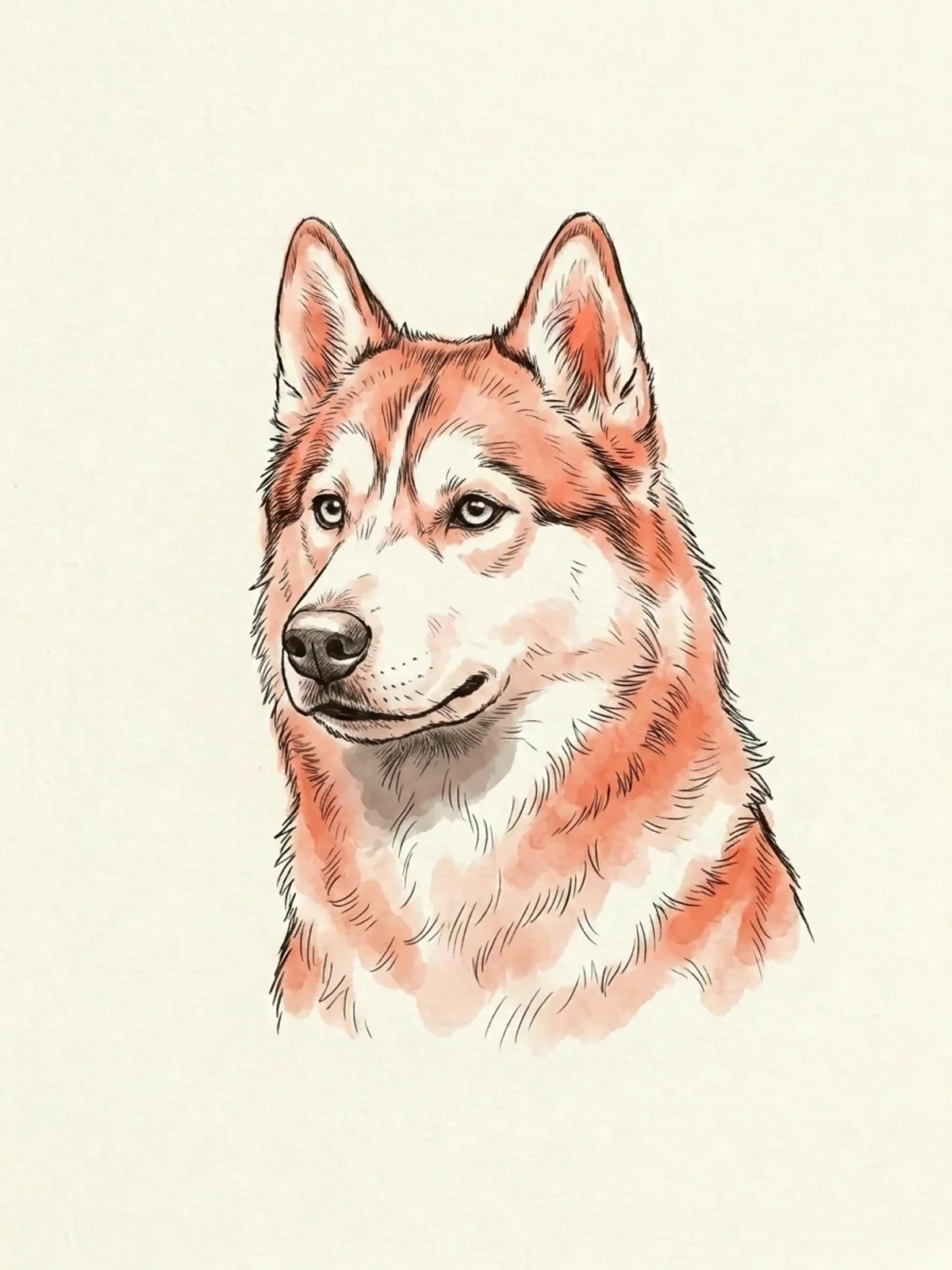
The Siberian Husky lives longer than its body size predicts. A typical Husky reaches 12 to 15 years, which puts the breed comfortably ahead of similar-sized working dogs like the Labrador Retriever (median around 12) and well ahead of the Golden Retriever (10 to 12). For a dog that weighs 20 to 27 kilograms and runs on sled-dog metabolism, that is unusual. The reason is older than the breed standard, older than the AKC, older than recorded canine breeding. The Husky’s longevity is a story about genetic diversity that most ranking pages skip past, and it is the most useful thing an owner can understand about the breed.
Key facts
- Typical lifespan: 12 to 15 years, with the median around 13, well above the ~11-year all-breed average
- Outlives similar-sized breeds: a median 1 to 2 years longer than the Labrador, 3+ years over the German Shepherd
- Why: high genetic diversity from ~10,000 years of working-line breeding, avoiding the modern conformation bottleneck
- Breed-specific risks: eye disease (PRA, juvenile cataracts) and zinc-responsive dermatosis, neither typically fatal
How long Siberian Huskies actually live
Most reputable sources put the Siberian Husky lifespan at 12 to 15 years, with the median sitting around 13 per Dogster and Walkin’ Pets, comfortably above the all-breed average of about 11 years. Some sources extend the upper bound to 16 for exceptionally well-cared-for dogs.
What stands out is the comparison. A Husky and a Labrador are nearly identical in weight class, but the Husky lives a median 1 to 2 years longer in most surveys. Compare a Husky to a German Shepherd of similar size and the gap widens to 3 or more years. This is the kind of intra-class difference that usually shows up between breeds of very different sizes, not between two medium-large working breeds, and it consistently shows up in pet-mortality data across the UK, US, and Scandinavian veterinary records.
The exceptional working-line records reach further still. Sled dogs in active competition have been recorded continuing to work into their teens, with anecdotal reports of dogs over 16 still pulling on recreational teams. Those numbers are not breed-average claims; they are signals of what the underlying biology allows when the lifestyle aligns with the breed’s evolutionary design.
Why Huskies often outlive other medium-large breeds
The honest answer is genetic diversity. Sled dog lineages in northeastern Siberia have been continuously bred for working function for roughly 10,000 years per Cornell Chronicle, making the Husky one of the closest extant breeds to ancestral working dogs. Two distinct lineages of Arctic dogs existed in Eurasia by the end of the Pleistocene, around 11,700 years ago, per Smithsonian. That long continuity means the breed never went through the modern conformation bottleneck that gave us the brachycephalic French Bulldog or the sloped-back show-line German Shepherd.
There is a meaningful within-breed split, however. A 2025 PMC study on breeding selection in US Siberian Huskies documented that show-population Huskies show the lowest heterozygosity (the lowest genetic diversity) in the breed, reflecting sustained inbreeding for conformation traits. Working sled-dog populations remain outbred for speed and endurance, which keeps their genetic diversity high. The working-line dogs, on average, are healthier and longer-lived than their show-line cousins. The Husky is one of the few breeds where this divide remains active in commercial breeding rather than being lost to history, and it is the single most important piece of information for someone choosing a puppy with longevity in mind.
The breed-specific conditions that actually matter
Cancer and orthopaedic disease, the dominant causes of death in most large breeds, are less prominent in Huskies. Hip dysplasia rates are lower than in Labradors or German Shepherds. What replaces them in the Husky mortality picture is mostly eye disease and skin disease, neither of which is fatal but both of which significantly affect quality of life.
The major eye conditions are juvenile cataracts (often appearing before age 2), progressive retinal atrophy (PRA), corneal dystrophy, and glaucoma per VetLens. PRA is the most serious because no treatment exists; the disease progresses from night blindness through complete vision loss over months to years. Genetic testing for the breed-specific PRA variant is available and reputable breeders use it. Annual eye exams by a veterinary ophthalmologist after age 2 are the practical owner standard.
Zinc-responsive dermatosis is a Husky signature condition. The breed absorbs dietary zinc poorly, and untreated dogs develop crusty, scaling skin around the eyes, muzzle, and feet per Husky Haven of Florida. It is not life-threatening but it is lifelong; affected dogs need daily oral zinc supplementation forever. The condition is genetic and breed-specific, which means owners arriving with skin complaints to a non-specialist vet are sometimes misdiagnosed. Knowing the breed signature ahead of time speeds the right diagnosis by months.
What you can actually do
Three actions change the odds for a Siberian Husky, layered on top of the general principles of extending a dog’s lifespan.
If you are buying a puppy, ask whether the breeder works to working-line standards or show-ring standards. The conformation question matters more in this breed than in most because the genetic diversity gap is documented and consequential. Working-line breeders typically also test for PRA and hereditary cataracts; show-line breeders do too, but the underlying gene pool is narrower.
Plan for the eye and skin programmes. Annual ophthalmology exams from age 2, daily zinc supplementation if the dermatosis presents (it usually does by age 1 to 2), and routine thyroid blood panels from age 4 onward. None of these are glamorous interventions; all of them keep a fundamentally healthy breed healthy.
Match exercise to the dog. A Husky bred for 10,000 years of sustained running cannot be kept fit on a 30-minute walk. The breed thrives on 1 to 2 hours of vigorous activity daily, and dogs whose owners cannot deliver that ration develop weight, behaviour, and cardiometabolic problems that subtract years over a lifetime. Lean body condition (score 4 or 5 of 9), real exercise, and the breed-specific medical surveillance above will let most Huskies reach the 14-to-15-year range that the genetic baseline actually allows. Every year counts.
See your Husky’s real age with the calculator, which uses the medium-large breed curve to give you a number that is actually true for your dog.