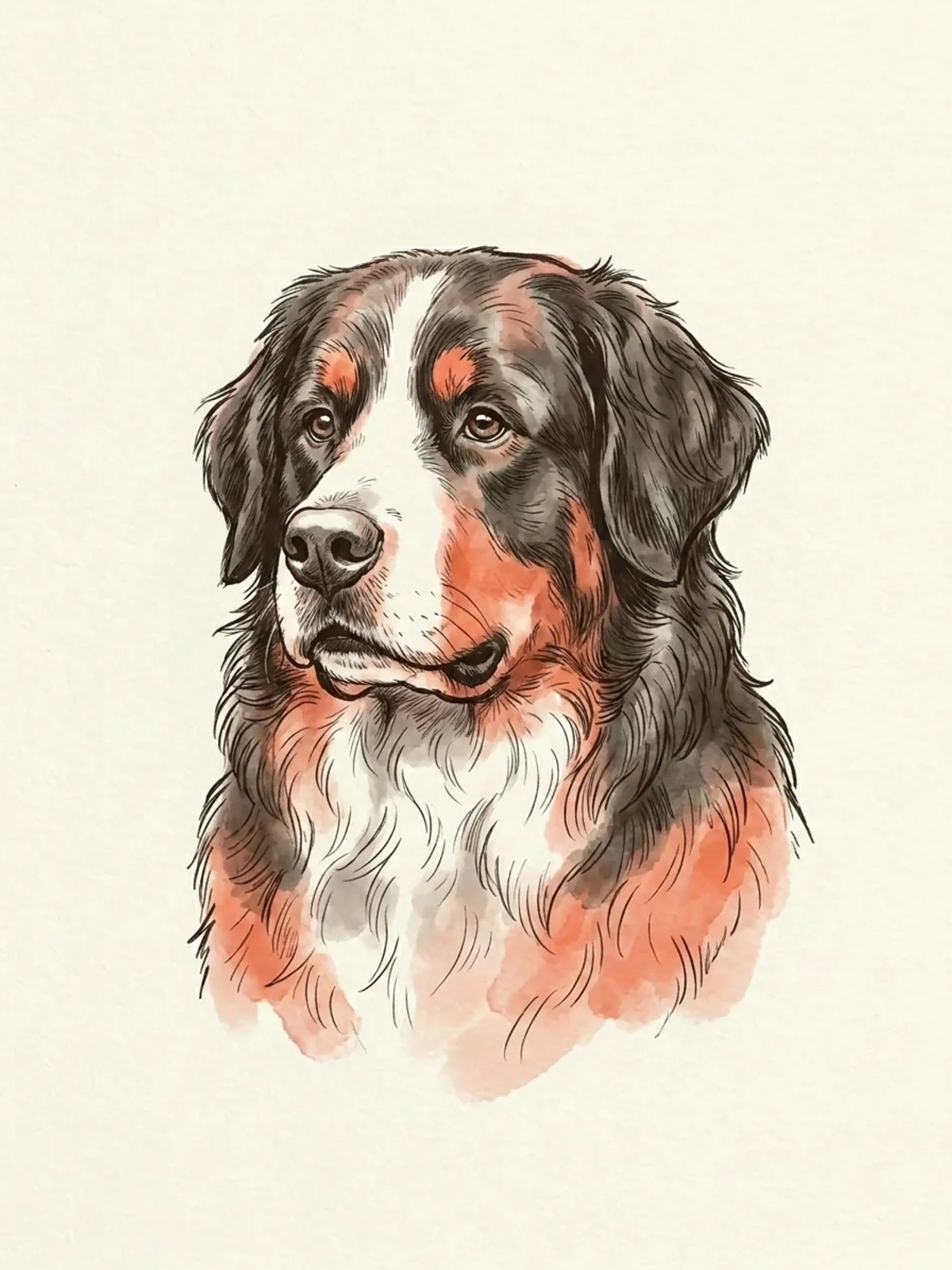
Bernese Mountain Dogs live 7 to 10 years, well below the all-breed average of about 11 years. That range is the documented reality for a breed most giant-dog owners already know carries a heavy health burden, not a rounding error or a pessimistic estimate. The short lifespan has two main drivers: an extraordinary vulnerability to cancer, and a skeletal frame that wears down faster than the dog’s gentle temperament ever suggests. Understanding both gives owners something real to work with.
Key facts
- Typical lifespan: 7 to 10 years (American Kennel Club); 8.4-year median in a 2016 Swiss study of 381 dogs (8.8 females, 7.7 males)
- Leading cause of death: cancer, at 58.3% of deaths in the Swiss study
- Histiocytic sarcoma affects roughly 25% of the breed; mean diagnosis age 6.5 years, median survival 30 days
- Joint disease is widespread: 24.5% had an elbow abnormality, 16.2% a dysplastic hip rating (OFA)
How long Bernese Mountain Dogs actually live
The clearest population data comes from a 2016 study published in BMC Veterinary Research (Klopfenstein et al.), which tracked 381 Swiss-born Bernese Mountain Dogs born in 2001 and 2002 until death. The median lifespan was 8.4 years overall: 8.8 years for females, 7.7 years for males. That sex gap is not trivial. Male Bernese carried more than three times the relative risk of dying from histiocytic sarcoma compared to females in the same cohort.
The American Kennel Club breed profile states the same 7 to 10 year window, and it aligns with the Swiss data. Dogs that reach 10 years are real but uncommon. Most owners planning for a Berner should plan around 8 years as the statistical midpoint, not 10 as a safe assumption.
Giant breed size is part of the explanation. Larger dogs age faster at the cellular level, a pattern documented across many species and dog breeds. But size alone does not explain why Berners die so young even compared to other giant breeds. Cancer does.
Cancer, and why histiocytic sarcoma matters most
Cancer killed 58.3% of the dogs in the BMC Veterinary Research Swiss study. That alone makes it the dominant cause of death by a wide margin over every other cause. Within that cancer burden, one disease stands out.
Histiocytic sarcoma is a malignancy of histiocytes, immune cells found throughout connective tissue and organs. A 2009 study in the Journal of Heredity (Abadie et al.) found that roughly 25% of all Bernese Mountain Dogs develop histiocytic sarcoma during their lifetime. The mean age at diagnosis is 6.5 years. Mean survival from diagnosis to death is 49 days, with a median of just 30 days. Fewer than 10% of affected dogs survived more than four months.
Those numbers are severe. The disease typically presents with internal organ involvement already in place: 82% of dogs in the Abadie study showed internal involvement at diagnosis, and 55% had multiple organ systems affected. By the time a dog looks visibly ill, the disease has usually spread.
The Bernese Mountain Dog Club of America Foundation acknowledges histiocytic sarcoma as a defining health challenge for the breed. Other cancers, including lymphoma and mast cell tumors, add to the burden, but no single diagnosis shapes this breed’s lifespan the way histiocytic sarcoma does.
Joints: the second major threat
Hip and elbow dysplasia do not kill Bernese Mountain Dogs at the rate cancer does, but they shorten functional life and affect quality of the years dogs do have.
A 2005 health survey reported through the Bernese Mountain Dog Club of America Foundation found that 24.5% of evaluated dogs, 205 out of 836, had an elbow abnormality. OFA registry data across more than 23,000 evaluations shows 16.2% of Bernese received a dysplastic hip rating, and that figure is likely conservative because dogs with obvious problems are sometimes not submitted for evaluation at all.
Elbow dysplasia in this breed is particularly worth watching. The BMDCA Foundation’s orthopedic documentation notes that elbow dysplasia may actually cause more lameness in Bernese than hip problems do, despite the two conditions often appearing together in the same dog. A Bernese with elbow dysplasia has an elevated probability of also having hip dysplasia, making full orthopedic screening more useful than screening for only one condition.
The practical consequence is that pain from joint disease often appears in middle age, around 5 to 7 years, precisely when cancer risk is also climbing. Managing both simultaneously is what Bernese ownership often looks like in the back half of a dog’s life.
What owners can actually do
The research does not point to a magic intervention. But it does point to several specific decisions that make a measurable difference, and the general principles of extending a dog’s lifespan apply on top with extra emphasis on cancer screening.
-
Source from health-tested lines. Both hip and elbow dysplasia have heritable components. The 2003 NCBI study on QTL mapping in Bernese confirmed genetic loci associated with both conditions. Breeders who clear sires and dams through OFA or equivalent programs reduce, though do not eliminate, the risk passed to offspring. Ask for documentation before purchasing a puppy.
-
Slow the puppy’s growth deliberately. Giant breeds fed for rapid early growth have higher rates of developmental orthopedic disease. A large-breed puppy food formulated for controlled growth, rather than maximum growth, is the standard veterinary recommendation for breeds like the Bernese.
-
Keep the dog lean. Excess weight multiplies the load on already-vulnerable joints. A Bernese that stays lean throughout life will have better mobility and may delay the onset of osteoarthritis. Your vet can assess body condition score at each visit.
-
Schedule twice-yearly vet exams after age 5. The mean age of histiocytic sarcoma diagnosis is 6.5 years. Annual exams in a dog that can develop and die from cancer in under two months are not frequent enough once the risk window opens. Twice-yearly visits with a full physical, blood panel, and lymph node assessment give the best practical chance of catching something earlier.
-
Know the early warning signs of histiocytic sarcoma. Unexplained weight loss, sudden lethargy, abdominal swelling, or rapid lameness in a previously mobile dog all warrant an immediate vet visit rather than a wait-and-see approach. Speed matters in this disease in a way it does not for most conditions.
-
Maintain joint mobility with low-impact exercise. Swimming and leash walks on soft surfaces keep muscles supporting dysplastic joints without the concussive load of hard running on pavement. This does not reverse dysplasia but does preserve function longer.
Every year with a Bernese Mountain Dog counts in a way that is different from owning a breed with a 14-year horizon. The short window is a reason to pay attention, not a reason to hold back. See your Bernese Mountain Dog’s real age with the calculator , which uses the giant breed curve to give you a number that is actually true for your dog.