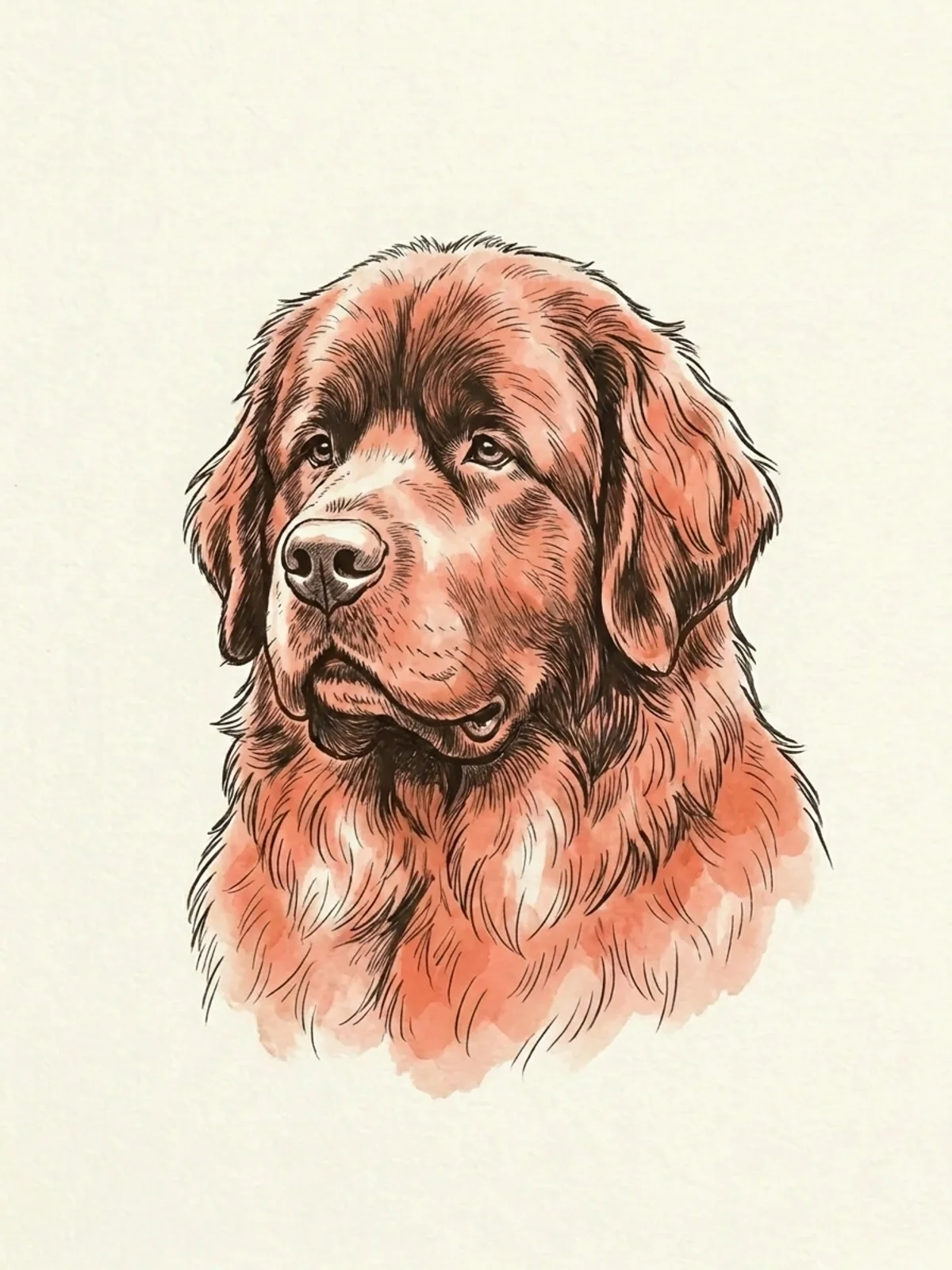
Newfoundlands live 9 to 10 years on average. That places them near the bottom of the popularity tables for canine lifespan, alongside the other giants they often share a vet waiting room with. Owners who pick this breed usually already know what they are signing up for: a dog that started its working life hauling fishing nets off the coast of a cold Canadian province, with webbed feet, a water-resistant double coat, and the temperament that earned the nickname “nanny dog.” The same biology that makes a Newfie a 130-pound swimming companion is also the reason the years feel short.
Key facts
- Typical lifespan: 9 to 10 years (American Kennel Club), two to three years below the all-breed midpoint
- Functionally a senior by age 7 due to giant-breed cellular aging
- Primary genetic risks: subaortic stenosis (most common congenital heart defect in the breed) and cystinuria
- Bloat (gastric dilatation-volvulus) is an elevated risk; prophylactic gastropexy worth discussing
How long Newfoundlands actually live
The American Kennel Club Newfoundland profile lists the breed’s expected lifespan as 9 to 10 years. That is consistent with what veterinary insurance data and breed club surveys have reported over the last two decades. A dog reaching 11 or 12 is real but uncommon, and 13 is a story owners tell each other rather than a planning assumption.
For context, our average dog lifespan guide puts the typical pet dog around 11 to 13 years across all sizes combined. Newfies sit two to three years below that midpoint, and the reasons are mostly mechanical. The Newfoundland Club of America keeps a running health information page for owners and breeders, and the picture it paints is the same one the academic literature shows: a few specific diseases do most of the damage, on top of a body that ages quickly because it is large.
If you want the full ranking of where Newfies sit relative to other breeds with similarly short spans, the shortest-living dog breeds guide covers the giant-breed cohort in detail.
Why giant-breed biology cuts the years short
A Newfoundland is built on the same trade-off every giant dog faces. Big dogs grow faster, reach skeletal maturity later, and burn through their cellular reserves at a rate small dogs do not. The why small dogs live longer guide walks through the underlying research, but the short version is that body size and lifespan track inversely across dog breeds, and the giants pay the steepest price.
Skeletal load is part of it. A 140-pound frame stresses hips, elbows, cruciate ligaments, and the heart in ways an 18-pound terrier never approaches. Hip and elbow dysplasia are close to universal concerns in the size class, which is why OFA hip and elbow scoring of breeding stock is standard practice in any reputable Newfoundland kennel. Buy from a breeder who cannot show you those scores and you have already accepted a risk the breed clubs spent decades trying to engineer out.
Cellular aging matters too. Larger bodies mean more cell divisions, more oxidative load, and a faster slide toward the diseases of older dogs. By the time a Newfie reaches 7, it is functionally a senior. The window for catching problems early starts narrowing right when most owners are still treating the dog like it has years to spare.
The Newfoundland-specific health risks
Three diseases show up in the breed at rates that distinguish Newfies from giant breeds in general.
Subaortic stenosis is a congenital narrowing of the aorta below the aortic valve. Newfoundlands carry one of the highest breed-specific rates of the condition documented in veterinary cardiology. A long-running PMC review of inherited cardiac disease identifies SAS as the most common congenital heart defect in the breed, with an autosomal dominant pattern of inheritance and severity that ranges from a quiet murmur picked up on a puppy exam to sudden cardiac death in a young adult. A board-certified cardiologist evaluation before breeding is the only reliable way to keep affected dogs out of the gene pool.
Cystinuria is the second one. It is an inherited defect in renal tubular reabsorption that causes the amino acid cystine to crystallize into bladder and kidney stones. The Newfoundland-specific form is well characterized, and PennGen at the University of Pennsylvania offers a DNA test that identifies carriers and affected dogs before they ever produce a litter. The test is inexpensive and definitive. Any breeder who skips it is taking a shortcut that costs puppy buyers years of management.
Bloat, or gastric dilatation-volvulus, rounds out the trio. Every deep-chested giant breed faces elevated GDV risk, and Newfies are no exception. Feeding two or three smaller meals a day instead of one large one, avoiding heavy exercise right after eating, and learning to recognize the early signs (unproductive retching, a visibly distended abdomen, restlessness) buys the time that determines whether a dog survives. A prophylactic gastropexy at the time of spay or neuter is worth a serious conversation with your vet.
Heat is the other thing worth naming. That gorgeous double water-resistant coat traps heat the way it was designed to trap warmth in the North Atlantic. A Newfie will overheat at temperatures a Lab handles fine. Air conditioning in summer is not a luxury for this breed; it is a basic husbandry decision.
What actually extends a Newfie’s life
The interventions that actually work are not exotic. They are the ones owners forget to do consistently.
Keep the dog lean. Every extra pound on a giant breed accelerates joint wear and shortens the functional years on either end. A body condition score check at each vet visit is worth more than most supplements.
Feed a large or giant breed puppy food during the growth window, not a calorically dense regular puppy formula. Controlled growth is what the orthopedic literature supports for breeds in this size class.
Move to twice-yearly vet exams once the dog turns 5. Cardiac auscultation, abdominal palpation, and a basic blood panel pick up the early signals of the diseases that actually kill Newfies, and an annual schedule is too slow for a breed that can lose a year of life expectancy to a missed murmur.
If you want a fuller framework for the lifestyle side, our how to extend your dog’s lifespan guide covers diet, exercise, dental care, and the rest of the boring stuff that quietly adds months.
A Newfoundland gives you fewer years than most breeds, but the years it does give you tend to be remarkable ones. Plan accordingly, screen the parents, watch the weight, and learn the warning signs early.
See your Newfie’s real age with the calculator, which uses the giant breed curve to give you a number that is actually true for your dog.