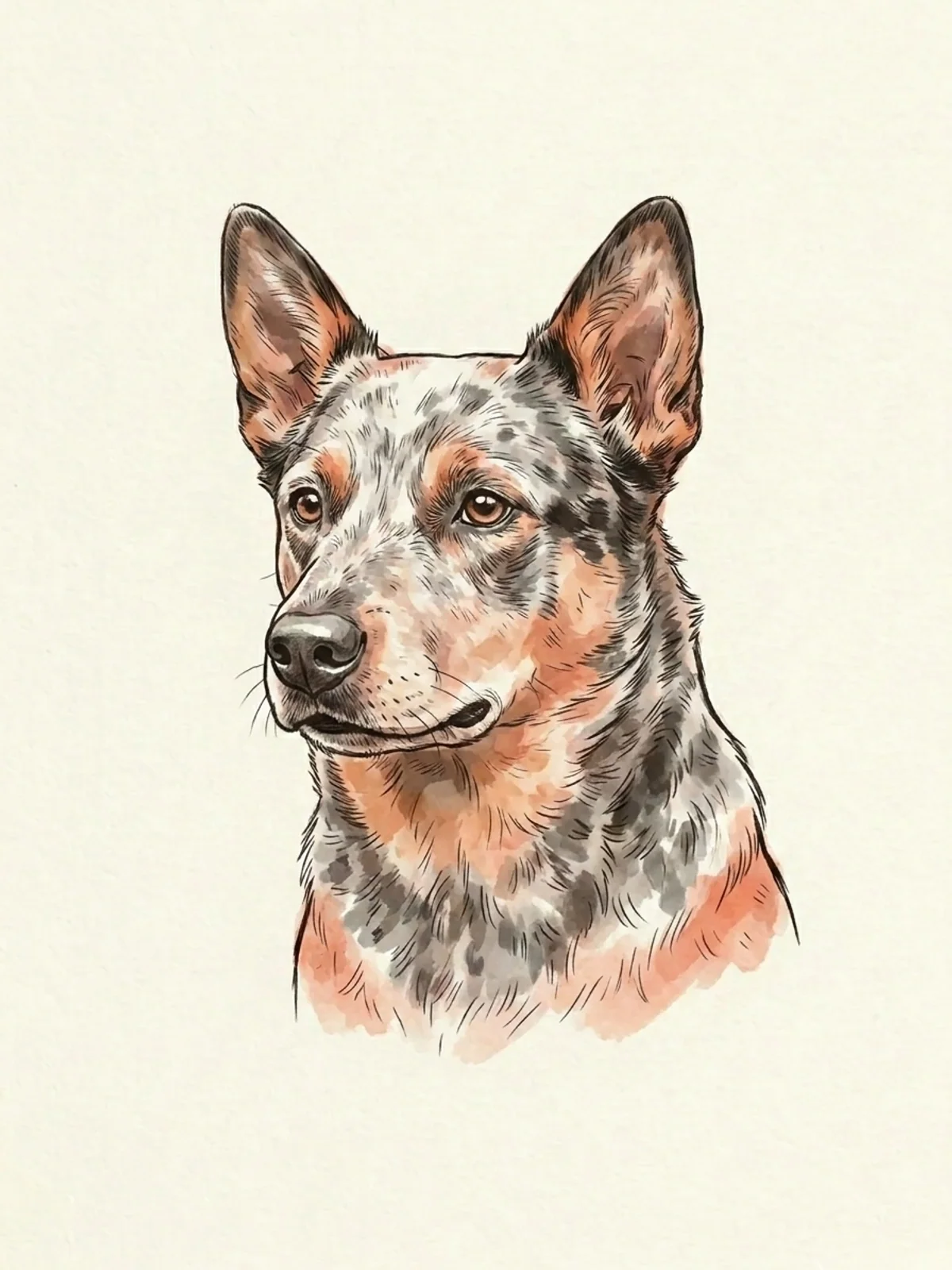
The American Kennel Club lists the Australian Cattle Dog at 12 to 16 years, which is a long run for any medium working breed. Most Blue Heelers land somewhere in the middle of that window, and a fair number reach 16 or 17 with reasonable care. The breed also holds the verified Guinness record for the oldest dog ever documented: an ACD named Bluey who lived 29 years and 5 months on a Victorian cattle farm, from 1910 to 1939, and worked stock for more than 20 of those years. No other breed sits this consistently at the top of the medium-dog longevity list.
Key facts
- Typical lifespan: 12 to 16 years (American Kennel Club); ~13-year average in the 2024 RVC VetCompass study
- Holds the verified Guinness record for oldest dog ever: Bluey, 29 years 5 months
- Congenital deafness affects roughly 7 to 12 percent of the breed, most often in one ear
- Main inherited risks: prcd-PRA (DNA-testable), congenital deafness, and moderate hip and elbow dysplasia
How long Cattle Dogs actually live
Twelve to sixteen years is the published AKC figure, and it matches what most owners and working-line breeders report. The 2024 Royal Veterinary College VetCompass study on dog longevity in the UK gave the breed an average closer to 13 years across a broad sample, which includes dogs lost early to accidents and untreated disease. Dogs from health-tested working lines, kept lean and worked appropriately, regularly clear 15.
Bluey is the extreme outlier rather than the rule, but he is not alone. A second ACD, Chilla, was reported to have reached 32 in Queensland, though that record was never independently verified to Guinness standards. Even setting Chilla aside, the breed produces more dogs in the 18-to-20 range than nearly any other working dog. The Australian Cattle Dog Club of America maintains a breed health page that puts the typical range at 12 to 15 with a meaningful tail of dogs past 16. Where you read the breed standard does not change the basic picture much.
This is a hardy dog. Compare the ACD to a similar-sized retriever or a Boxer and the difference in expected lifespan is large.
Why this breed lives so long
Two genetic factors stack in the Cattle Dog’s favour. The first is body size. Medium dogs in the 30 to 50 pound range sit in the canine longevity sweet spot, long enough lived to clear small-dog reproductive-stage problems and small enough to escape the cancer and joint failure that take large breeds in their eighth or ninth year. The size paradox is laid out in detail in why small dogs live longer, and the ACD demonstrates the medium-band advantage about as well as any breed does.
The second factor is working-line breeding pressure. The ACD was developed in 19th-century Australia by crossing Dingoes with imported Collies, Dalmatians, and Black-and-Tan Kelpies, with the goal of producing a dog tough enough to drive cattle across the outback. The breed was working stock before it was show stock, and most pedigrees still trace back to functional cattle dogs rather than ring winners. That keeps the gene pool wider than it is in most modern breeds, and it has shielded the ACD from the heavy inbreeding bottlenecks that have shortened lifespans in popular companion breeds. The average dog lifespan data is clear that working-line dogs of any breed tend to outlive their show-line cousins.
The breed’s main health concerns
Three conditions account for most of the breed’s serious health problems, and none of them is universal. Progressive retinal atrophy (PRA) is the inherited eye disease most often discussed in ACD circles. A DNA test for the prcd-PRA mutation is widely available, and responsible breeders test their stock. Affected dogs slowly lose night vision in middle age and may go fully blind by 8 or 9, but the condition is not painful and dogs adapt well.
Congenital deafness is the second concern, and it is tied to the breed’s white-pigmented coat genetics. A PMC paper on canine deafness in piebald and merle breeds put the prevalence in Australian Cattle Dogs at roughly 7 to 12 percent, with most affected dogs deaf in one ear rather than both. Reputable breeders BAER-test puppies before placement, which means you can know your puppy’s hearing status before you bring it home. Bilaterally deaf ACDs can live full lives, but the working-dog drive plus deafness is a difficult combination for first-time owners.
Hip and elbow dysplasia round out the list. Rates are moderate, lower than in larger working breeds, but worth screening for through OFA evaluations of breeding stock. Lean body weight across the dog’s life does more to protect the joints than any supplement on the market.
What actually extends an ACD’s life
The ACD’s exercise requirement is the part most new owners underestimate, and it bears directly on how long the dog lives. A Cattle Dog without a job will invent one, usually a destructive one, and chronic under-stimulation produces the kind of stress and anxiety that shortens lives in any breed. Two hours of real physical work daily plus mental challenges is a baseline, not a maximum. These are not apartment dogs and the math does not change because the apartment is in the country.
Keep the dog lean. Excess weight accelerates joint disease and is associated with shorter lifespans across every breed studied. Annual vet exams from age 7 onward, with blood panels added to catch the kidney and liver changes that do not show up in behaviour until late, are the standard senior-care recommendation. More on the practical playbook is in how to extend your dog’s lifespan.
Get the genetic tests done. Prcd-PRA status, BAER hearing test for puppies, and hip evaluation for any dog you plan to breed or work hard. None of this is exotic and all of it is cheap relative to a 15-year veterinary relationship.
Bluey’s 29 years are not the target. Twelve to sixteen good years with a dog that has work to do is the realistic picture, and that already puts the breed at the top of the medium-dog longevity list. The longest living dog breeds ranking has the ACD in the top tier for working breeds, and it is there on merit.
See your Cattle Dog’s real age with the calculator, which uses the medium breed curve to give you a number that is actually true for your dog.