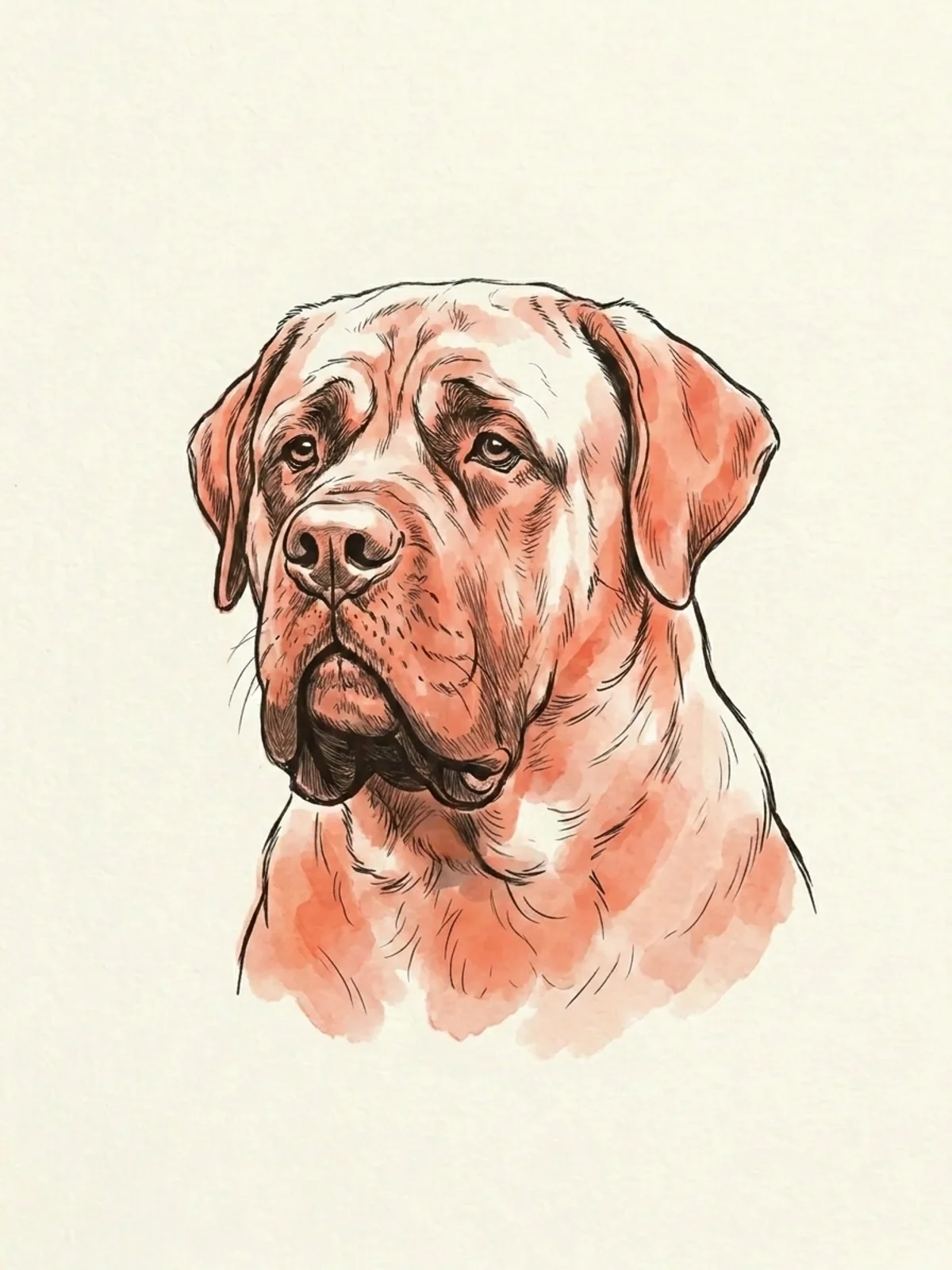
The Mastiff lives about 6 to 10 years, well below the all-breed average of about 11 years and one of the shortest figures of any popular breed. A male English Mastiff carries 70 to 100 kilograms of body mass on a frame that finishes growing well before the cellular bill comes due, and the bill comes due fast. Most of what shortens a Mastiff’s life traces back to one thing: the cost of being that large in a species whose biology was tuned by selection on much smaller animals. Owners who know what is coming get to keep their dogs longer.
Key facts
- Typical lifespan: 6 to 10 years (American Kennel Club), one of the shortest of any popular breed
- Body mass is the dominant predictor: every ~4.4 kg of adult mass costs about one month of lifespan (Greer 2007)
- Leading cause of death: bloat (gastric dilatation-volvulus); prophylactic gastropexy strongly recommended
- Second mortality risk: dilated cardiomyopathy; screen with echocardiogram from age five
How long Mastiffs actually live
The American Kennel Club Mastiff breed profile puts the breed’s life expectancy at 6 to 10 years. Eight is a fair median. Eleven is uncommon. Twelve is a story you tell at the dog park. A handful of well-cared-for Mastiffs reach 13 or 14, and those animals are almost always lean, lightly exercised, and from lines where the breeder can name the age of every grandparent at death.
The shape of the range matters more than the average. A 95-kilogram dog and a 60-kilogram dog of the same breed will not live the same length of time. Lean Mastiffs at the lower end of the breed weight range routinely outlast their heavier littermates by years, which is the most actionable single fact in this article.
The breed also carries a population-genetics story that affects the floor of the range. The English Mastiff nearly went extinct after the Second World War, rebuilt from about 14 dogs in the United Kingdom and a small handful of American imports. That bottleneck still shows up in elevated inbreeding coefficients and reduced immune diversity, both of which press on health outcomes that compound late in life.
Why body size dominates the lifespan story
The cleanest result in canine longevity research is the inverse relationship between adult body mass and lifespan. The 2007 Greer and colleagues paper in Research in Veterinary Science analyzed lifespan data from tens of thousands of dogs across breeds and found that weight was the dominant predictor, with every roughly 4.4 kilograms of adult mass associated with about a one-month reduction in expected lifespan. Project that curve out to a 90-kilogram Mastiff and the predicted lifespan lands almost exactly where the AKC range sits.
The mechanism is partly hormonal. Large breeds carry higher circulating IGF-1 from puppyhood through adulthood, and IGF-1 accelerates cellular turnover, oxidative stress, and the rate at which tissues approach their replicative limits. A Mastiff puppy that gains over a kilogram a week for its first year is paying for that growth with cellular wear that does not stop when the growth plates close.
This is also why the Mastiff sits with the Great Dane and the Bernese Mountain Dog at the short end of the AKC table, rather than with breeds it superficially resembles. Body class predicts lifespan more reliably than ancestry, working role, or coat type. The Mastiff’s clock is set by its mass.
The big emergencies: bloat, cardiac, joints
Gastric dilatation-volvulus, called bloat, is the emergency that ends more Mastiff lives than any other single cause. The stomach distends with gas, twists on its long axis, cuts off its own blood supply, and the dog has hours. The Ward and colleagues 2003 paper on prophylactic gastropexy quantified the protective effect across breeds and found mortality reductions ranging from 2.2-fold in Rottweilers to 29.6-fold in Great Danes, with the Mastiff falling inside that high-benefit band. The surgery permanently tacks the stomach to the body wall and effectively eliminates the volvulus that does the killing. Most board-certified surgeons recommend it for Mastiffs as a routine add-on at spay or neuter, when the abdomen is already open. Declining it is the choice that needs the justification.
Dilated cardiomyopathy is the second mortality story. Mastiffs show a meaningful incidence of DCM and other adult-onset cardiomyopathies, and the breed-specific screening guidance from the Mastiff Health Foundation recommends annual cardiac auscultation from age three and an echocardiogram from age five. Catching the disease in its occult phase, before the dog collapses, is the realistic path to extending the timeline.
Hip and elbow dysplasia round out the orthopedic picture. Any breed routinely above 50 kilograms carries skeletal load that joint structures were not selected to handle indefinitely. The contributing factor owners actually control is puppyhood nutrition: ad libitum feeding and excess calcium during the first 18 months of a giant-breed puppy’s growth raise the prevalence of dysplasia, panosteitis, and hypertrophic osteodystrophy. A large-breed puppy formula with controlled calcium, fed by measured weight to a lean body condition score of 4 on the 9-point scale, is the standard of care.
Heat tolerance is the quiet killer. Mastiffs do not dissipate heat well, and a brachycephalic-leaning palate plus a thick coat plus a 90-kilogram body produces heat-stroke risk in conditions a Labrador would shrug off. Limit exercise above about 22 degrees Celsius and provide cool resting surfaces year-round.
What actually extends a Mastiff’s life
Four decisions change the odds, and the general principles of extending a dog’s lifespan apply on top with extra emphasis on leanness and gastropexy.
Schedule prophylactic gastropexy at spay or neuter. For a Mastiff, this is the single most effective surgical decision available, and the evidence base is settled.
Keep the dog lean for life. Body condition score 4 on the 9-point scale, ribs palpable under a thin fat cover, visible waist from above. Lean Mastiffs outlast heavy Mastiffs, full stop.
Feed a large-breed puppy diet by measured weight through the first 18 to 24 months. Slow, steady growth produces sounder joints and a Mastiff that reaches eight without an orthopedic surgery.
Screen the heart. Annual auscultation from age three, echocardiogram from age five, repeated yearly. A baseline echo against which to compare the next one is the difference between catching DCM and being surprised by it.
The Mastiff was bred to be enormous, and enormous is biologically expensive. What careful ownership buys you is the right end of the breed range, away from the emergencies that pull the average down. For a dog this big, two extra years is most of the difference between a short life and a full one.
See your Mastiff’s real age with the calculator, which uses the giant breed curve to give you a number that is actually true for your dog.