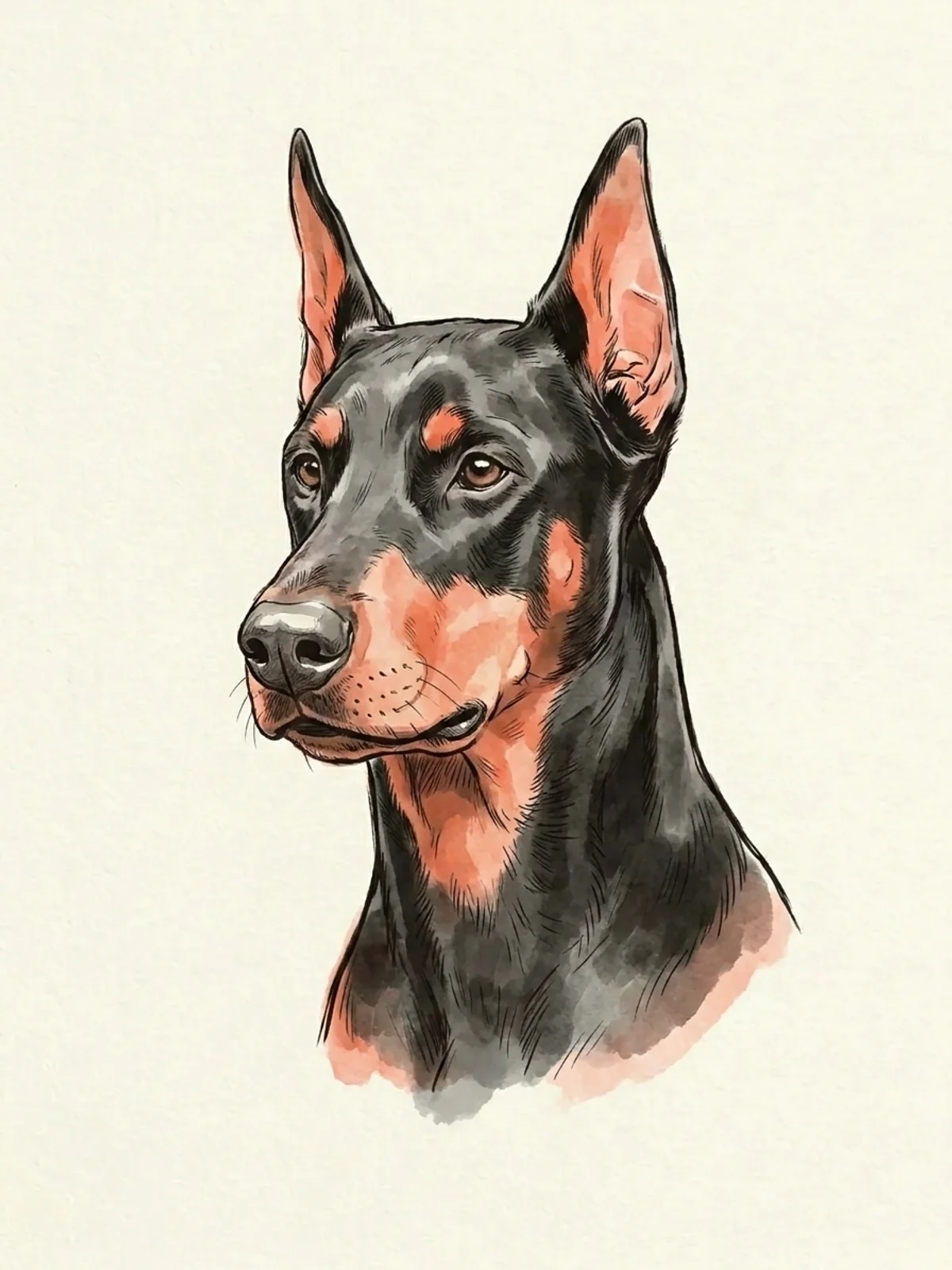
The Doberman Pinscher lives about 10 to 12 years according to the American Kennel Club breed profile. That range is misleading on its own. One disease, dilated cardiomyopathy, accounts for most of the deaths that pull the average down, and it does so quietly. A Doberman can appear athletic and well at age six while a failing heart is already remodelling. The breed is unusually well studied, and the screening protocols that exist can shift the odds for an individual dog more than for almost any other breed.
Key facts
- Typical lifespan: 10 to 12 years (American Kennel Club)
- Leading cause of death: dilated cardiomyopathy (DCM), cumulative prevalence ~60% in European and ~40% in North American Dobermans
- Treatment window: pimobendan extended median time to heart failure or death to 718 vs 441 days (PROTECT trial)
- Screening: annual Holter monitoring plus echocardiography from age 3 (DPCA protocol)
How long Dobermans actually live
The 10 to 12 year AKC figure sits roughly in the middle of large-breed averages and close to the all-breed average of about 11 years, but Doberman mortality data tells a different story than the headline. Cardiac death is the leading cause of death in the breed, and the age curve is shifted left compared to other large dogs. Many Dobermans who reach 12 do so without a cardiac diagnosis. The ones who do not often die at 7, 8, or 9 of sudden arrhythmic death or congestive heart failure. The breed average reflects that bimodal pattern rather than a tidy distribution.
European working lines appear to fare somewhat better on lifespan than American show lines, though the data is limited and confounded by population size and screening culture. Geography alone does not decide outcome. Within either population, the dogs who reach 13 or 14 tend to come from lines with documented cardiac screening across three or more generations. Sex differences are small in this breed compared with the orthopaedic and cancer-driven breeds; males and females die of the same heart disease at roughly the same ages.
Dilated cardiomyopathy is the story
Doberman dilated cardiomyopathy has the highest lifetime prevalence of any breed studied. Cumulative prevalence reaches roughly 60 percent in European Dobermans and 40 percent in North American Dobermans according to the PLOS One UK cohort study on TTN, PDK4, and RNF207 mutations. The disease is autosomal dominant with variable penetrance, which means a single copy of a risk allele can be enough.
Two gene mutations have been mapped in detail. A splice-site deletion in PDK4 and a missense variant in TTN were identified in North American cohorts, and a JAVMA study of 48 affected Dobermans found that 38 of them carried the TTN variant, alone or in combination with PDK4. The UK paper noted that those same variants are present in European Dobermans but with a weaker statistical link to disease, suggesting other modifier loci. DNA testing through several labs is available now and worth doing in any breeding programme, with the caveat that a clean test does not mean a clean heart.
The long preclinical phase is the actionable part. A Doberman can have measurable left-ventricular dilation or ventricular ectopy years before any cough, faint, or exercise intolerance. The Doberman Pinscher Club of America cardiac protocol recommends annual Holter monitoring plus echocardiography starting at age three. A 24-hour Holter catches the arrhythmic phenotype that an in-clinic ECG will miss. An echocardiogram catches the dilated phenotype.
What changes if you catch it early? The PROTECT trial of pimobendan in preclinical DCM, published by Summerfield and colleagues in 2012, randomised 76 Dobermans with echo evidence of preclinical disease to pimobendan or placebo. Median time to congestive heart failure or sudden death was 718 days on pimobendan versus 441 days on placebo. That is roughly nine extra months of life for a drug that costs a few dollars a day. Starting pimobendan at the right moment is one of the few veterinary interventions with a randomised survival benefit in dogs.
Other Doberman health risks
Von Willebrand disease, an inherited bleeding disorder, is common enough in Dobermans that DNA testing of breeding stock is the breed norm. The clinical impact for most pet owners is limited to surgical bleeding, and a responsible breeder will provide the parents’ test results before the puppy goes home.
Cervical vertebral instability, often called wobbler syndrome, affects a meaningful minority of Dobermans, usually presenting between ages four and seven as a wobbly hind end or neck pain. Hypothyroidism runs in the breed and is easily managed once diagnosed but is easy to miss for months without a TSH and free T4 panel. Gastric dilatation-volvulus is a deep-chested-breed risk and prophylactic gastropexy at the time of spay or neuter eliminates the volvulus component.
Cancer is present but not breed-defining the way it is in Rottweilers or Bernese Mountain Dogs. Most Dobermans who die in middle age die of their heart, not a tumour. Owners often discover this the hard way when a six-year-old Doberman collapses on a walk and never wakes up. That presentation is almost always cardiac.
What actually extends a Doberman’s life
The most useful decision is annual cardiac screening from age three, paired with a willingness to start pimobendan the moment preclinical DCM is documented, alongside the general principles of extending a dog’s lifespan. Holter plus echo is more expensive than a regular check-up. It is also the only screen with a randomised drug trial behind it.
The second decision is lineage. Ask any Doberman breeder for at least three generations of cardiac results, ideally with Holter and echo data attached. Lines with consistent screening across generations produce dogs with later disease onset on average. Lines with no screening data are providing information by omission.
The third is lean weight and steady exercise. A Doberman at body condition score 4 or 5 on the 9-point scale puts less mechanical work on a heart that may already be at genetic risk. Daily aerobic exercise rather than weekend sprints suits the breed’s cardiovascular profile. Feed measured meals and weigh the dog quarterly; a Doberman who creeps from 35 to 40 kilograms over two years is loading roughly 15 percent more work onto every heartbeat.
None of this prevents DCM. What it does is buy time inside the disease, often years of it, which for a breed with this much genetic loading is the realistic goal.
See your Doberman’s real age with the calculator, which uses the large breed curve to give you a number that is actually true for your dog.